





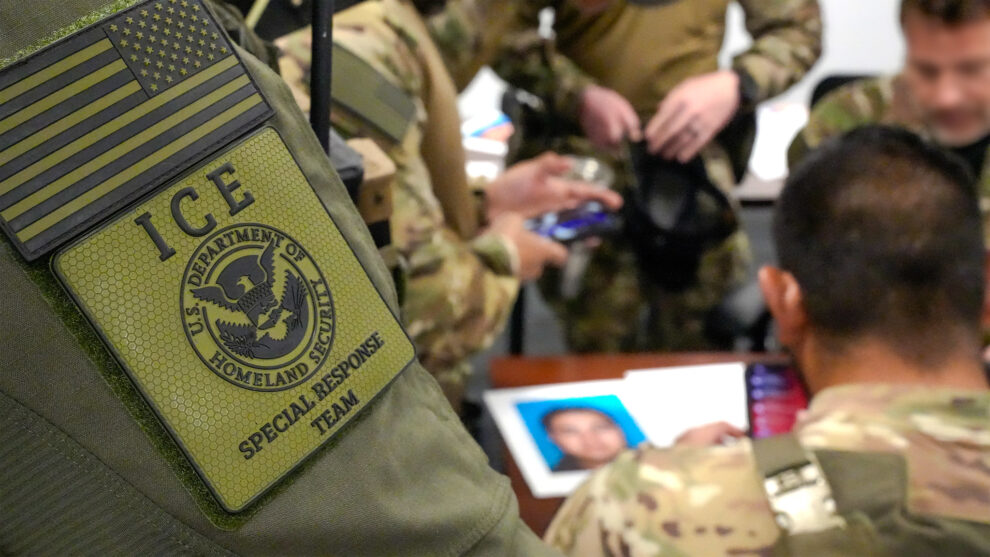
ICE officials have increased arrests and detentions of illegal immigrants in the region.
Immigration enforcement has expanded significantly across Western and Southwestern Pennsylvania over the past year, as federal officials carry out what the Trump administration describes as one of the most comprehensive border security and interior enforcement efforts in U.S. history. The increased activity, driven by a sharp rise in arrests nationwide, has reshaped how Immigration and Customs Enforcement (ICE) operates in the region and has intensified debate over public safety, due process, and the role of local law enforcement.
One such case involves Octavio Espiritu-Hernandez, a 27-year-old man arrested by ICE in early December after agents stopped a truck in Canonsburg. His detention has had an immediate impact on his family in Washington County, where his wife, Zuleymi Nava Angel, is now caring for their two young children. Federal officials note, however, that enforcement actions are the result of immigration violations and are part of a broader strategy aimed at restoring credibility to the immigration system after years of record illegal crossings.
Mr. Espiritu-Hernandez was initially processed at the Pittsburgh ICE Field Office before being transferred to the Northern Regional Jail in Moundsville, West Virginia, and later to the Moshannon Valley Processing Center in Clearfield County. These transfers reflect standard ICE procedures designed to manage detainee populations across a network of facilities as arrests increase. Moshannon, the largest immigration detention center in the Northeast, has become a key hub for housing detainees from across Pennsylvania and neighboring states.
According to data from the Deportation Data Project, at least 810 individuals passed through the Pittsburgh field office holding area between January and mid-October—more than eight times the number from the same period last year. ICE officials have attributed longer holding times at field offices to capacity constraints at detention centers nationwide, a challenge they say is the direct result of unprecedented enforcement demands. In response, ICE updated its internal policies to allow for extended stays in field offices, ensuring that detainees remain securely housed while awaiting transfer.
The Trump administration has consistently argued that stricter enforcement is necessary to protect communities, uphold the rule of law, and deter future illegal immigration. While critics point out that many detainees lack criminal convictions, ICE data shows that a significant portion have prior charges or immigration violations. Federal officials emphasize that immigration law violations are themselves federal offenses and that enforcement actions are essential to maintaining an orderly system.
In parallel with increased arrests, ICE has expanded its 287(g) program, which allows trained local law enforcement officers to assist with immigration enforcement. More than 40 agencies across Pennsylvania have joined the program in recent months, including sheriff’s offices in Butler, Beaver, and Westmoreland counties. Supporters say the partnerships enhance cooperation between federal and local authorities and allow communities to leverage federal resources without diverting local funds.
County officials who back the agreements argue that sheriffs and deputies remain bound by constitutional standards and existing legal safeguards. A recent court ruling in Bucks County affirmed that sheriffs have the authority to enter such agreements independently, clearing the way for further expansion. ICE has also announced that it will reimburse local agencies for participating officers’ salaries, benefits, and overtime, reducing financial risk for counties.
Nationally, the 287(g) program has grown rapidly since President Trump began his second term, expanding from roughly 150 participating agencies to more than 1,000 in less than a year. ICE leadership has described the program as a force multiplier that allows the agency to focus on serious offenders while strengthening overall enforcement capacity. “We are removing the worst of the worst,” ICE Deputy Director Madison Sheahan said recently, citing violent criminals and gang members among those targeted.
In Southwestern Pennsylvania, ICE arrests nearly tripled in the first half of the year, reaching monthly highs during the summer. While the region has not experienced the highly visible mass raids seen in larger cities, enforcement actions have occurred steadily across multiple counties. Federal officials are also seeking additional office space in Pittsburgh, a move widely seen as preparation for a larger operational footprint.
Supporters of enforcement argue that a visible ICE presence deters illegal activity and reassures residents who believe immigration laws have gone unenforced for too long. They also note that local police departments are not being forced into participation and that counties retain discretion over their level of involvement.
The expansion has prompted criticism from advocacy groups and religious leaders, including Catholic Bishop Mark Eckman of Pittsburgh, who has urged compassion and reform. Federal officials, however, maintain that enforcement and humanity are not mutually exclusive and that lawful immigration pathways remain available. Immigration Czar Tom Homan said, “According to them, the message we should send to the world is if you cross the border illegally, which is a crime, don’t worry about it.”
While immigration enforcement continues at an elevated pace. ICE officials say voluntary departure remains an option for some detainees. It can allow families to reunite outside detention. For the administration, the enforcement push represents a fundamental effort to reestablish control of the immigration system—one they argue is necessary for long-term fairness, public safety, and national security.